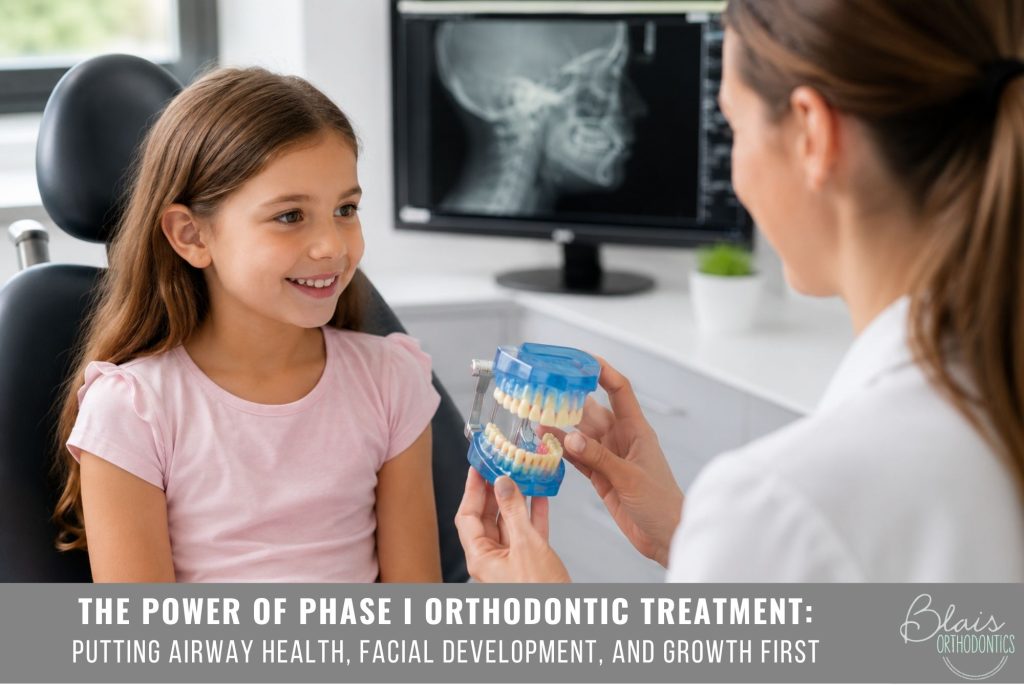
Orthodontic treatment is often associated with straightening teeth and creating a beautiful smile. While properly aligned teeth certainly provide aesthetic and functional benefits, modern orthodontics has evolved far beyond cosmetic improvements. At Blais Orthodontics, we believe that Phase I orthodontic treatment is about something much bigger—supporting healthy airway development, guiding proper facial growth, and creating the foundation for lifelong oral and overall health.
Children experience remarkable growth during their early years, and this growth presents an opportunity that simply cannot be recreated later in life. While teeth can be aligned at almost any age, facial growth and jaw development occur during a limited window. Phase I orthodontic treatment focuses on making the most of this critical developmental period to improve health first, while also supporting future orthodontic success.
What Is Phase I Orthodontic Treatment?
Understanding Early Interceptive Orthodontics
Phase I orthodontic treatment, also known as interceptive orthodontics, typically begins between the ages of 6 and 10, when a child has a mixture of baby teeth and permanent teeth. Rather than waiting until all adult teeth have erupted, orthodontists evaluate whether early treatment can positively influence jaw growth, airway development, and facial structure.
Not every child requires Phase I treatment. However, for children with specific developmental concerns, early intervention can provide significant long-term benefits that extend far beyond straight teeth.
Why Timing Matters More Than Tooth Alignment
Growth Is a Limited Opportunity
One of the greatest advantages of Phase I treatment is the ability to guide jaw and facial development while a child is still growing. Bones are naturally more adaptable during childhood, allowing orthodontic treatment to influence growth patterns in ways that are impossible after skeletal maturity.
Once facial growth is complete, treatment options become more limited. While braces or clear aligners can straighten teeth later in life, they cannot recreate the same opportunities to guide jaw development during childhood.
This is why early orthodontic evaluations are so important—even if treatment is not immediately recommended.
Airway Development: An Essential Part of Children’s Health
Why the Airway Matters
Healthy breathing is one of the most important aspects of childhood development. The size and shape of the upper jaw, lower jaw, palate, and surrounding facial structures all influence the airway.
When the airway is narrow or restricted, children may develop breathing patterns that affect sleep quality, energy levels, concentration, and overall development.
Modern orthodontics increasingly recognizes the close relationship between facial growth and airway development. While orthodontic treatment alone is not intended to diagnose or treat sleep-disordered breathing or obstructive sleep apnea, guiding healthy jaw development may help create additional space within the oral cavity and support normal growth patterns when appropriate.
When concerns about breathing or sleep are identified, orthodontists often work alongside pediatricians, ENT physicians, sleep specialists, and other healthcare providers to ensure comprehensive care.
Healthy Facial Development Begins Early
More Than Straight Teeth
The upper and lower jaws serve as the foundation for the entire face. Proper development influences:
- Facial symmetry
- Bite function
- Speech development
- Chewing efficiency
- Nasal breathing
- Long-term oral health
If the jaws do not develop harmoniously, children may experience crowding, crossbites, open bites, or other bite discrepancies that become more difficult to address later.
Phase I treatment aims to encourage balanced skeletal development during the years when growth is most responsive.
The Role of the Upper Jaw
Why the Maxilla Is So Important
The upper jaw, or maxilla, influences much more than tooth positioning. It also supports the nasal cavity, cheeks, palate, and surrounding facial structures.
When the upper jaw develops appropriately, there is often more room for permanent teeth to erupt into healthier positions and for facial structures to develop proportionally.
In some children, carefully planned orthodontic treatment may help guide upper jaw development when clinically indicated.
Guiding Proper Jaw Growth
Helping the Upper and Lower Jaws Work Together
Children’s jaws do not always grow at the same rate. Some develop narrow upper arches, while others have jaw discrepancies that affect their bite.
Early orthodontic treatment may help guide jaw relationships while growth is still occurring. This proactive approach can improve bite function and create a more stable foundation for future orthodontic treatment.
Every child’s growth pattern is unique, which is why individualized evaluation is essential.
Creating Space for Permanent Teeth
Reducing Future Crowding
One common goal of Phase I treatment is helping permanent teeth erupt into healthier positions.
When space is limited, permanent teeth may erupt crooked, impacted, or severely crowded. By encouraging proper arch development during childhood, orthodontic treatment may reduce the severity of crowding and simplify future treatment.
While early treatment cannot guarantee avoidance of tooth extractions or future orthodontic treatment, it can often improve the overall treatment process for appropriately selected patients.
Supporting Healthy Oral Function
Beyond Appearance
Healthy oral development affects everyday activities including:
- Chewing
- Swallowing
- Speaking
- Breathing
- Jaw comfort
- Bite stability
Phase I treatment focuses on creating a functional bite that supports healthy growth throughout childhood.
Why Every Child Should Receive an Orthodontic Evaluation
The American Association of Orthodontists Recommendation
The American Association of Orthodontists recommends that children receive their first orthodontic evaluation by age 7.
This does not mean every child needs braces at age 7.
Instead, an early evaluation allows an orthodontist to identify developing concerns before they become more complex. In many cases, children simply continue to be monitored until the ideal treatment time arrives.
Conditions That May Benefit from Phase I Treatment
Early Signs Parents Should Watch For
An orthodontic evaluation may be beneficial if your child has:
- Crowded or overlapping teeth
- Crossbite
- Underbite
- Open bite
- Difficulty chewing
- Mouth breathing
- Thumb or finger sucking habits beyond early childhood
- Early or delayed loss of baby teeth
- Narrow dental arches
- Speech concerns related to oral development
- Significant jaw asymmetry
Only a comprehensive examination can determine whether early treatment is appropriate.
Phase I Is About Health First
Building a Foundation for Life
At Blais Orthodontics, we believe orthodontic care should always prioritize long-term health.
While beautiful smiles are certainly an important outcome, the real value of Phase I treatment often lies in supporting healthy growth, improving function, encouraging balanced facial development, and helping create an environment where permanent teeth can erupt more naturally.
Every treatment recommendation is individualized based on each child’s unique growth, development, and orthodontic needs.
Why Families Choose Blais Orthodontics
Expertise in Growth-Focused Orthodontic Care
Choosing an orthodontist involves much more than selecting braces or aligners. It means partnering with a team that understands the relationship between facial growth, jaw development, airway considerations, and lifelong oral health.
At Blais Orthodontics, we carefully evaluate each child’s growth pattern and create personalized treatment recommendations based on comprehensive clinical findings. Our goal is to support healthy development while helping children achieve functional, confident smiles that last a lifetime.
Frequently Asked Questions
What is the ideal age for a child’s first orthodontic evaluation?
The American Association of Orthodontists recommends scheduling an orthodontic evaluation by age 7. This allows developing issues to be identified early, even if treatment is not needed immediately.
Does every child need Phase I orthodontic treatment?
No. Many children only require observation until they are older. Phase I treatment is recommended only when early intervention is expected to provide meaningful benefits based on a child’s growth and development.
Is Phase I treatment only about straightening teeth?
No. One of the primary goals of Phase I treatment is to guide jaw growth, support facial development, improve bite function, and create a healthier environment for permanent teeth to erupt.
Can adults receive the same type of treatment?
Adults can achieve excellent tooth alignment with orthodontic treatment. However, once facial growth is complete, the opportunity to guide jaw development through growth modification is no longer available.
Does Phase I treatment eliminate the need for braces later?
Not always. Many children benefit from a shorter Phase II treatment after all permanent teeth have erupted. Early treatment often focuses on growth and development rather than final tooth alignment.
Can orthodontic treatment treat sleep apnea?
Orthodontic treatment is not a treatment for obstructive sleep apnea or other sleep disorders. However, orthodontists consider airway development as part of comprehensive growth evaluation and may collaborate with physicians and sleep specialists when concerns are present.
How long does Phase I treatment usually last?
Treatment length varies depending on each child’s needs but often ranges from 9 to 18 months, followed by a monitoring period until permanent teeth have erupted.
How do I know if my child is a candidate?
The best way to determine whether Phase I treatment is appropriate is through a comprehensive orthodontic evaluation that includes examination of facial growth, bite development, jaw relationships, and dental eruption.
Contact Information
Blais Orthodontics
2 Overhill Rd Suite 300
Scarsdale, NY 10583
Phone: (914) 472-9595
Website: https://blaisortho.com
Schedule an early orthodontic evaluation with Blais Orthodontics to learn how growth-focused care can support your child’s healthy development, functional bite, and confident smile.