
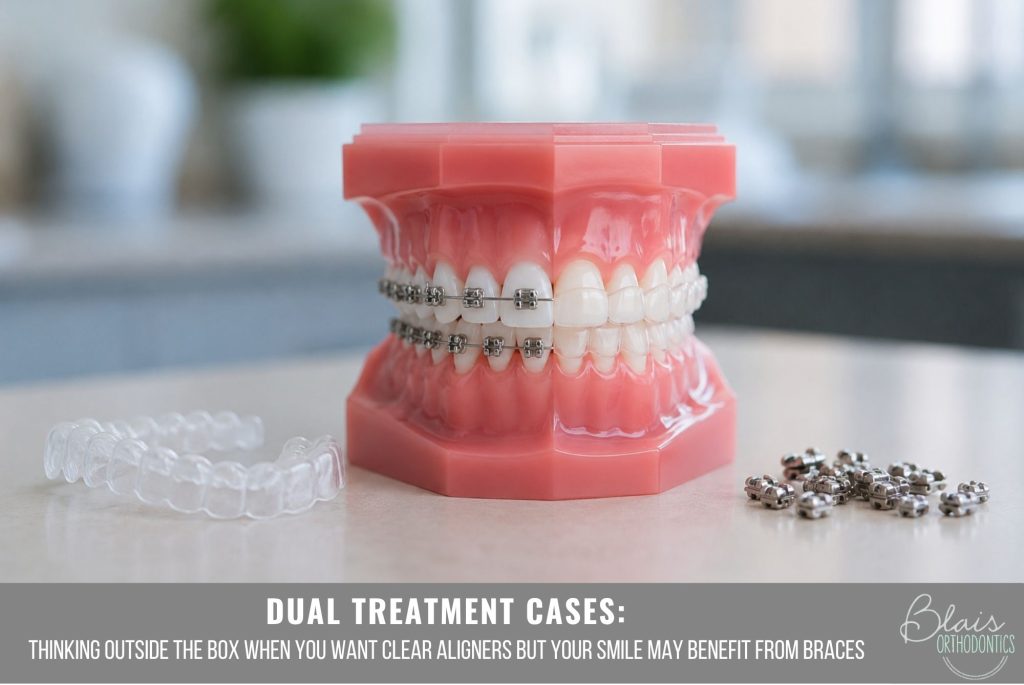
Orthodontic treatment has never been more personalized than it is today. While traditional braces remain one of the most effective treatment options for correcting complex orthodontic concerns, many patients prefer the convenience and appearance of clear aligners. Fortunately, choosing one does not always mean giving up the other.
At Blais Orthodontics, treatment planning is never a one-size-fits-all process. Dr. Blais believes in thinking outside the box to create individualized solutions that balance clinical excellence with each patient’s personal goals. In many situations, a dual treatment approach that combines braces and clear aligners can provide outstanding results while maximizing comfort, efficiency, and aesthetics.
Why Every Orthodontic Case Is Different
Every smile has its own unique anatomy, growth pattern, bite relationship, and treatment challenges. Some patients have mild crowding that is easily corrected with clear aligners, while others have significant bite discrepancies, impacted teeth, severe rotations, or jaw development concerns that require additional mechanics.
The treatment option that works best depends on many factors, including:
Tooth Position
Some teeth are much more difficult to move than others. Teeth that are severely rotated, tipped, or impacted often respond more predictably with braces during certain phases of treatment.
Bite Alignment
Correcting overbites, underbites, crossbites, and open bites often requires precise force systems. In some cases, braces provide greater control during key stages of treatment.
Bone and Facial Development
Especially in younger patients, orthodontic treatment often focuses on guiding facial growth and jaw development rather than simply straightening teeth. Functional treatment goals sometimes require appliances or braces before transitioning into aligners.
Patient Lifestyle and Preferences
Some patients prioritize aesthetics, while others want the shortest possible treatment time or the fewest office visits. Understanding these priorities helps determine the ideal treatment sequence.
Clear Aligners Are Excellent—but They Are Not Always the Complete Solution
Clear aligners have transformed orthodontics. They offer numerous advantages, including:
- Nearly invisible appearance
- Removable for eating and brushing
- Comfortable smooth plastic
- Easy oral hygiene
- Fewer dietary restrictions
However, clear aligners are not automatically the best solution for every stage of every orthodontic case.
Certain tooth movements remain more predictable with braces, including:
- Significant tooth rotations
- Large vertical tooth movements
- Certain bite corrections
- Moving impacted teeth
- Complex root positioning
- Coordinating multiple challenging movements simultaneously
This does not mean patients must choose braces for their entire treatment.
What Is a Dual Orthodontic Treatment Approach?
A dual treatment approach combines the strengths of traditional braces with the benefits of clear aligners.
Rather than viewing braces and aligners as competing treatment options, Dr. Blais evaluates how each system can contribute to the best possible outcome.
Treatment may begin with braces to accomplish difficult movements before transitioning into clear aligners for finishing and detailing. In other situations, aligners may be used for most of treatment while limited braces are temporarily placed only where additional control is needed.
This individualized strategy often allows patients to enjoy the cosmetic benefits of aligners without compromising treatment quality.
When Might Braces Be Used First?
Beginning treatment with braces may be recommended when:
Teeth Need Significant Rotation
Round teeth such as canines and premolars sometimes require greater rotational control than aligners alone can efficiently provide.
Impacted Teeth Need Guidance
Braces are frequently used to help guide impacted teeth into their proper positions.
Bite Correction Requires Greater Precision
Complex bite mechanics may initially respond more effectively to braces before finishing with aligners.
Space Needs to Be Created
Braces can efficiently level and align arches before transitioning to removable aligners for final detailing.
When Can Treatment Transition to Clear Aligners?
Once more challenging movements have been completed, many patients become excellent candidates for clear aligners.
During this phase, aligners can:
- Fine-tune tooth positioning
- Improve smile aesthetics
- Refine the bite
- Close small remaining spaces
- Maintain excellent oral hygiene
- Provide a more discreet appearance during the remainder of treatment
Many patients appreciate having braces for only a portion of their overall treatment.
Limited Braces Can Also Be an Option
Some patients never require full braces.
Instead, Dr. Blais may recommend placing brackets on only a few teeth while using clear aligners throughout the remainder of treatment.
This targeted approach can solve specific movement challenges while preserving the cosmetic advantages of aligners.
Personalized Treatment Planning Leads to Better Outcomes
Modern orthodontics is about selecting the right tool at the right time.
Rather than recommending the same appliance for every patient, Dr. Blais carefully evaluates:
Digital Imaging
Advanced imaging allows detailed evaluation of tooth position, roots, jaw relationships, and facial structures.
Digital Treatment Simulation
Technology helps visualize potential treatment sequences and determine whether a combined approach offers additional advantages.
Growth and Development
For children and adolescents, timing treatment with natural growth can improve long-term outcomes.
Patient Goals
Some patients prioritize aesthetics during work or school. Others prioritize efficiency or minimizing treatment time. These preferences are incorporated into every treatment plan whenever clinically appropriate.
The Advantages of Combining Braces and Clear Aligners
A hybrid treatment approach offers several potential benefits.
Greater Treatment Flexibility
Using multiple orthodontic techniques allows treatment to adapt as teeth respond.
Improved Efficiency
Certain movements can often be completed more efficiently with braces before transitioning to aligners.
Excellent Cosmetic Appeal
Patients may spend less overall time wearing visible braces.
Precise Finishing
Clear aligners are excellent for making detailed finishing adjustments after more complex movements have been completed.
Customized Care
Every treatment plan is designed specifically for the individual patient rather than fitting the patient into a standard treatment protocol.
Technology Makes Hybrid Treatment Easier Than Ever
Today’s digital orthodontic technology allows orthodontists to seamlessly integrate different treatment methods.
Digital scans eliminate messy impressions while providing highly accurate models for planning.
Three-dimensional treatment planning improves precision, helps predict tooth movement, and allows Dr. Blais to make informed decisions throughout every phase of care.
This level of customization helps ensure treatment remains both efficient and predictable.
Why Experience Matters in Complex Orthodontic Cases
Successfully combining braces and clear aligners requires careful diagnosis, treatment sequencing, and biomechanical expertise.
Knowing when to transition from one appliance to another can significantly influence treatment efficiency and overall results.
At Blais Orthodontics, every recommendation is based on achieving healthy function, facial harmony, long-term stability, and beautiful aesthetics—not simply choosing one appliance over another.
If your orthodontic needs are more complex but you have always hoped to wear clear aligners, don’t assume your options are limited. A customized hybrid treatment plan may provide the ideal balance between effectiveness and aesthetics.
Frequently Asked Questions
Can I switch from braces to clear aligners during treatment?
Yes. Many patients begin treatment with braces and later transition to clear aligners once more complex tooth movements have been completed. Whether this is appropriate depends on your specific orthodontic needs.
Why can’t every orthodontic case be treated with clear aligners alone?
While clear aligners are highly effective for many orthodontic conditions, certain complex tooth movements and bite corrections can sometimes be managed more predictably with braces or a combination of treatment methods.
Will switching between braces and aligners make treatment take longer?
Not necessarily. In many cases, using each appliance when it is most effective can improve efficiency and help achieve excellent results without extending treatment time.
Are hybrid orthodontic treatments more comfortable?
Many patients appreciate limiting the amount of time they wear braces while enjoying the convenience and aesthetics of clear aligners during much of their treatment.
Can adults benefit from a combination of braces and aligners?
Absolutely. Many adult patients choose hybrid treatment because it provides effective correction while minimizing the time they spend wearing traditional braces.
Will people notice if I switch to aligners?
Once treatment transitions to clear aligners, most people find them very discreet. They are designed to fit closely over the teeth and are often difficult to notice during everyday conversations.
Is a consultation necessary to determine if hybrid treatment is right for me?
Yes. A comprehensive orthodontic evaluation allows Dr. Blais to assess your teeth, bite, facial structure, and treatment goals before recommending the most appropriate treatment plan.
Contact Information
Blais Orthodontics
2 Overhill Rd Suite 300
Scarsdale, NY 10583
Phone: (914) 472-9595
Website: https://blaisortho.com