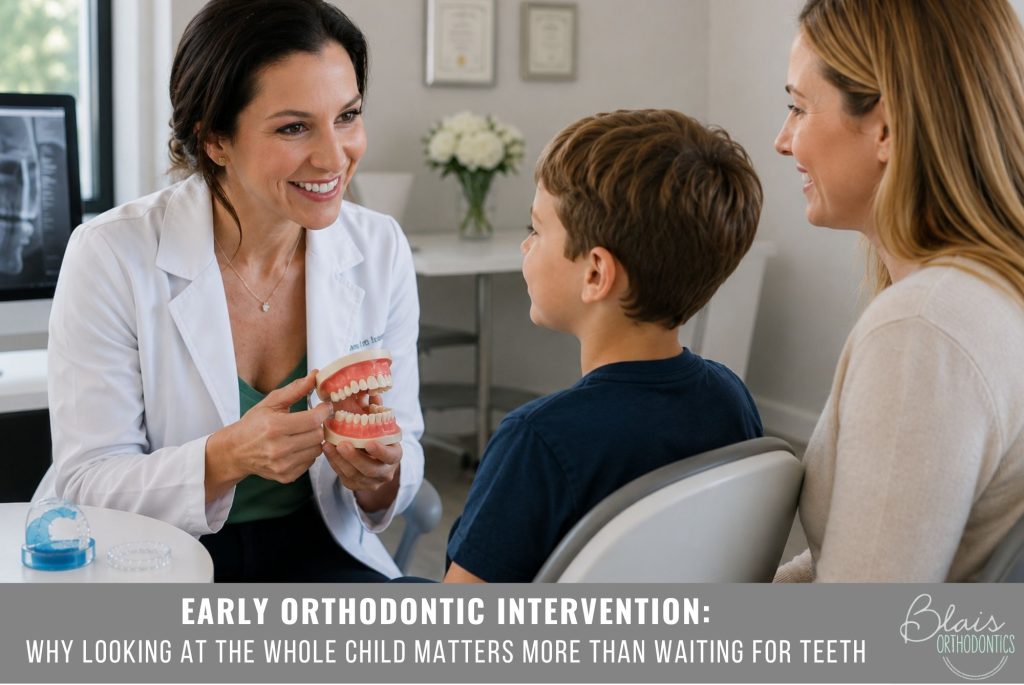
When most people think about orthodontics, they picture crooked teeth, braces, or clear aligners. While creating a beautiful smile is certainly important, modern orthodontics has evolved far beyond simply straightening teeth. At Blais Orthodontics, we believe every child deserves a comprehensive evaluation that considers their overall health, facial development, breathing, sleep quality, and quality of life—not just the position of their teeth.
An airway-focused approach to orthodontics recognizes that the developing face, jaws, tongue, and airway all work together. When these structures do not develop properly, children may experience challenges that extend far beyond their smiles. Early orthodontic intervention allows us to identify potential concerns while a child is still growing, giving us the opportunity to guide healthy development instead of waiting until problems become more difficult to address.
Why Traditional Orthodontic Timing Doesn’t Always Tell the Whole Story
For decades, many families have been told to “wait until more permanent teeth come in” before considering orthodontic treatment. While this timing may be appropriate for correcting certain tooth alignment issues, it does not necessarily apply when a child shows signs of impaired jaw development or airway concerns.
The question becomes:
What are we waiting for?
If a child demonstrates signs of poor facial growth, restricted airway development, chronic mouth breathing, poor sleep, or other functional concerns, delaying evaluation until a specific tooth erupts may mean allowing those issues to persist during critical years of growth.
The bones of the face develop rapidly throughout childhood. During this period, orthodontic guidance can often influence jaw growth and create a healthier environment for breathing and overall development.
Orthodontics Is About More Than Straight Teeth
Healthy facial growth supports much more than an attractive smile.
The upper and lower jaws help determine:
- Airway size
- Tongue posture
- Nasal breathing
- Bite development
- Facial balance
- Speech function
- Long-term oral health
When the jaws are narrow or underdeveloped, the airway may also be smaller. While not every child with a small jaw experiences breathing difficulties, many children with restricted jaw development exhibit signs that deserve careful evaluation.
At Blais Orthodontics, we examine the relationship between facial growth, function, and overall wellness so that treatment recommendations are based on the entire child—not simply their teeth.
The Importance of Healthy Airway Development
Children are meant to breathe comfortably through their noses while awake and asleep.
Consistent nasal breathing helps support:
- Healthy oxygen exchange
- Proper tongue posture
- Balanced facial growth
- Improved sleep quality
- Efficient muscle function
- Healthy jaw development
When nasal breathing becomes difficult, many children compensate by breathing through their mouths. Chronic mouth breathing can influence how the facial bones grow over time and may contribute to narrowing of the upper jaw and dental arches.
Because facial growth is strongly influenced by function, identifying these concerns early allows orthodontists to determine whether growth guidance may be appropriate.
Signs That May Suggest an Airway or Growth Concern
Parents often focus on crowded teeth because they are easy to see. However, many important signs involve a child’s daily behaviors and sleep habits.
Potential signs that deserve evaluation include:
- Chronic mouth breathing
- Snoring
- Restless sleep
- Frequent nighttime waking
- Sleeping with the mouth open
- Dark circles beneath the eyes
- Teeth grinding during sleep
- Bedwetting beyond the expected age
- Difficulty concentrating
- Daytime fatigue
- Irritability
- Hyperactivity
- Crowded teeth developing at an early age
- Narrow palate
- Long facial appearance
- Difficulty keeping lips comfortably closed
None of these signs automatically indicate an orthodontic problem, nor do they confirm a specific medical diagnosis. However, when several occur together, they may suggest that a comprehensive airway-focused orthodontic evaluation is appropriate.
Sleep Quality Affects More Than Energy
Sleep plays a critical role in childhood growth and development.
Poor-quality sleep can influence:
- Learning
- Memory
- Emotional regulation
- Mood
- Physical growth
- Immune function
- Academic performance
- Athletic performance
When children do not sleep well, the effects often appear during the day.
Instead of looking sleepy, many children become:
- Hyperactive
- Easily frustrated
- Emotionally reactive
- Unable to focus
- Impulsive
- Difficult to wake in the morning
Because these symptoms overlap with many childhood conditions, including attention and behavioral disorders, an airway-focused orthodontic evaluation can become one valuable piece of a broader healthcare assessment. Orthodontists do not diagnose conditions such as ADD or ADHD, but evaluating facial growth and airway development may help identify structural factors that could contribute to poor sleep. Collaboration with the child’s pediatrician and other healthcare professionals remains essential.
Underdeveloped Jaws Can Influence More Than the Bite
The upper jaw serves as the foundation for much of the midface.
When it develops properly, it helps support:
- Healthy nasal passages
- Appropriate tongue position
- Balanced facial appearance
- Adequate room for erupting teeth
When the upper jaw is narrow or underdeveloped, children often have less space for both their teeth and their tongue. This can contribute to crowding while also affecting how the tongue functions during breathing, swallowing, and speech.
Likewise, lower jaw development influences bite function, facial harmony, and airway relationships.
Because these structures continue developing throughout childhood, early orthodontic intervention can often work with natural growth rather than attempting to correct problems after growth is complete.
Growth Is an Opportunity
One of the greatest advantages of early orthodontic treatment is that children are still growing.
Rather than forcing teeth into position after the jaws have matured, growth-guided orthodontics seeks to optimize the development that is already occurring naturally.
Depending on the child’s needs, treatment goals may include:
- Supporting healthy jaw development
- Improving arch width
- Creating room for permanent teeth
- Encouraging proper oral function
- Promoting nasal breathing when appropriate
- Improving bite relationships
- Reducing the complexity of future orthodontic treatment
Every child is unique. Some children benefit from early intervention, while others are best monitored until additional growth occurs. A thorough examination helps determine the most appropriate timing.
Why Waiting Isn’t Always the Best Option
One of the most common questions parents ask is:
“Shouldn’t we just wait?”
The answer depends on what we are treating.
If the concern is simply minor tooth alignment, monitoring growth may be entirely appropriate.
However, if a child already demonstrates signs of restricted jaw development, compromised airway anatomy, persistent mouth breathing, or functional concerns, delaying evaluation simply because certain permanent teeth have not erupted may mean missing an important window during which growth can be guided more effectively.
Every year of childhood represents valuable developmental time. If an issue can be identified and appropriately managed earlier, a child may benefit from improved growth, function, and quality of life during those formative years rather than waiting for problems to become more pronounced.
Early Orthodontics Is a Team Approach
Airway-focused orthodontics often involves collaboration with other healthcare professionals.
Depending on a child’s individual needs, coordinated care may include:
- Pediatricians
- Ear, nose, and throat physicians (ENTs)
- Sleep medicine specialists
- Myofunctional therapists
- Speech-language pathologists
- Pediatric dentists
This multidisciplinary approach helps ensure that every aspect of the child’s growth and health is considered.
Why Families Choose Blais Orthodontics
At Blais Orthodontics, we believe orthodontics should support lifelong health—not simply straighten teeth.
Our comprehensive evaluations focus on:
- Facial growth
- Jaw development
- Airway considerations
- Oral function
- Bite relationships
- Long-term stability
- Individualized treatment planning
By evaluating the whole child, we strive to provide treatment recommendations that support healthy development while creating confident, beautiful smiles.
Frequently Asked Questions
At what age should my child have their first orthodontic evaluation?
The American Association of Orthodontists recommends an orthodontic evaluation by age 7. This allows developing concerns involving jaw growth, bite relationships, and erupting teeth to be identified while children are still growing.
Does every child need early orthodontic treatment?
No. Many children only require monitoring. A comprehensive examination helps determine whether treatment should begin early or whether observation is the best approach.
Can orthodontics improve sleep?
Orthodontic treatment is not a treatment for sleep disorders. However, in appropriate cases, guiding jaw development and improving oral structures may be one component of a broader multidisciplinary approach to supporting healthy airway function. Children with sleep concerns should also be evaluated by their pediatrician or an appropriate medical specialist.
Is mouth breathing normal?
Occasional mouth breathing during illness is common. Persistent mouth breathing should be evaluated because it may indicate airway, nasal, or structural concerns that warrant further assessment.
Can crowded teeth be a sign of jaw development issues?
Crowding often occurs because there is insufficient space within the developing jaws for permanent teeth. A comprehensive orthodontic evaluation helps determine the underlying cause and whether early treatment could be beneficial.
Can poor sleep affect behavior?
Research has shown that inadequate sleep can influence attention, mood, learning, and emotional regulation in children. Many factors contribute to these issues, so evaluation by appropriate healthcare professionals is important.
Will my child still need braces later?
Some children who receive early intervention will still benefit from braces or clear aligners during adolescence. Early treatment often simplifies future orthodontic care and addresses developmental concerns during critical growth periods.
How do I know if my child should be evaluated?
If your child snores, mouth breathes, sleeps poorly, has crowded teeth, struggles with restless sleep, or exhibits other concerns related to facial growth or oral function, scheduling an orthodontic evaluation can help determine whether further assessment is appropriate.
Contact Information
Blais Orthodontics
2 Overhill Rd Suite 300
Scarsdale, NY 10583
Phone: (914) 472-9595
Website: https://blaisortho.com